


The Mistake of Cutting with the Tip of Your Shears (And When to Use It Correctly)
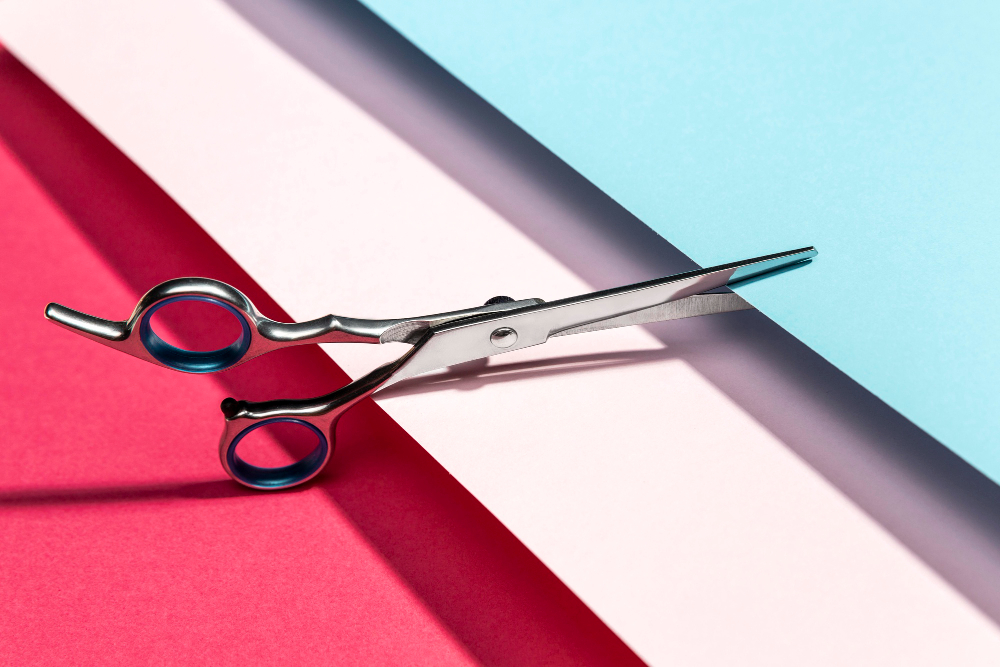
Watch a stylist cut hair. Notice where the blades make contact. Many stylists cut almost exclusively with the tips of their shears. They nibble at the ends, snip at the perimeter, and rarely let the full blade touch the hair. They have learned that the tip is for precision. And they are half right. The tip is for precision. But it is not for everything. In fact, cutting with the tip when you should be using the base or the middle of the blade is a mistake that slows you down, fatigues your hand, and produces uneven results.
Your shear blade is not a uniform tool. It has three distinct zones, each designed for a different purpose. Understanding these zones transforms how you cut.
The base of the blade is the section closest to the pivot. This is the strongest part of the shear. It has the most leverage and the most cutting power. The base is designed for heavy work: removing bulk, cutting through thick sections, and making long, straight lines. When you cut with the base, the shears do the work. Your hand simply guides them.
The middle of the blade is the workhorse. It balances power and precision. This is where most of your cutting should happen. The middle is ideal for general cutting, layering, and creating shape. It gives you control without requiring excessive force. When you watch a master stylist cut, their shears seem to glide. That is because they are using the middle of the blade, not the tip.
The tip of the blade is for detail work only. Point cutting, texturizing the ends, softening a perimeter, trimming around the ears, and cutting in tight curves. The tip has the least leverage and the least power. It requires more hand force and more precision. Using the tip for heavy work is like using a scalpel to chop wood. It can be done, but it is inefficient, exhausting, and hard on the tool.
The most common mistake is cutting entire sections with the tip. The stylist opens the shears wide, then closes them using only the last quarter inch of the blade. Each snip removes a tiny amount of hair. To cut through a full section, they snip again and again and again. The result is a choppy, uneven line and a tired hand. The same section cut with the base or middle of the blade would take one or two smooth closures.
Another common mistake is using the tip to cut blunt perimeters. A blunt perimeter requires a clean, straight line. The tip, by its nature, creates a slightly curved or angled cut because the blades are narrower at the end. Cutting a blunt line with the tip is like drawing a straight line with a wobbly pencil. It can be done, but it takes more concentration and produces inferior results. The base of the blade, with its full width and straight edge, creates a cleaner line with less effort.
So when should you use the tip? Use the tip for point cutting. Slide the tip into the ends of the hair and snip at an angle to create softness and texture. Use the tip for detail work around the ears, the nape, and the hairline where precision matters and the sections are small. Use the tip for softening a blunt perimeter after you have established the line with the base or middle of the blade. Use the tip for cutting into curls or working in tight spaces where the full blade cannot fit.
How do you train yourself to use the right part of the blade? Start by paying attention. The next time you cut, notice where the blades are making contact. Are you constantly at the tip? Consciously move your shears deeper into the section. Let the hair slide further between the blades. Feel the difference in resistance. The base requires less force. Your hand will tell you when you are in the right place.
Practice on a mannequin. Cut an entire haircut using only the base and middle of the blade. Do not allow yourself to use the tip except for finishing details. You will be slower at first because you are breaking a habit. But you will also notice that your cuts are smoother, your lines are cleaner, and your hand is less tired. Speed will come with practice.
The shears themselves will tell you when you are using the wrong zone. If you feel resistance, if the shears are pushing instead of cutting, if you are having to squeeze harder than usual, you are probably too far out on the tip. Move deeper into the blade. The resistance will disappear.
Your shears are designed with a specific geometry for a reason. The blade gets narrower toward the tip because the tip is for detail. The blade is wider at the base because the base is for power. Using each zone for its intended purpose is not cheating. It is engineering. It is efficiency. It is the difference between fighting your tools and letting them work for you.
The next time you pick up your shears, remember: the tip is not the default. It is a specialized tool within a tool. Use it for detail. Use the middle for most of your work. Use the base for power. Your cuts will improve. Your hand will thank you. And your shears will last longer. That is not just technique. That is mastery


