


Tension Control Mechanics: Preventing Micro-Push when Cutting Heavy Sections
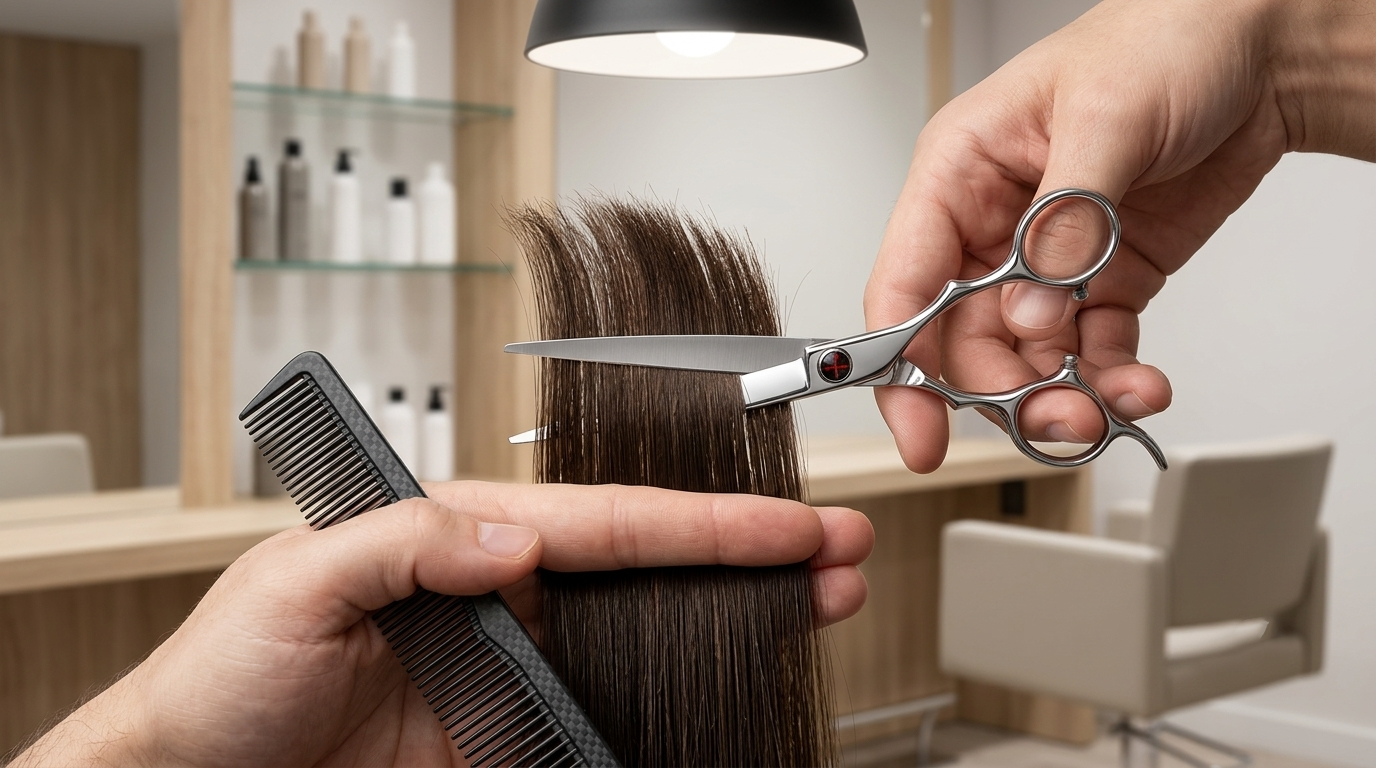
Every stylist who strives for absolute geometric precision has encountered the frustration of “micro-push”—that subtle, unwanted displacement where hair slides forward along the shear blade during a cut. Rather than a clean, instantaneous point of contact, the dense mass of hair pushes toward the tip of the shear, causing subtle wave patterns or uneven lengths along what should be a perfectly straight section. Mastering tension control mechanics and understanding blade dynamics are critical steps to eliminating micro-push entirely.
The Physics of Blade Displacement
Micro-push occurs when the mechanical resistance of the hair section exceeds the cutting force and grip of the shear’s edge. When you close your blades on a thick, dense panel of hair, several forces come into play:
Inadequate Pivot Tension: If the tension screw of your shear is too loose, the blades flex slightly apart under resistance. This gap allows the hair to wedge between the blades and slide outward toward the tip instead of being cleanly sliced.
Extreme Entry Angles: Entering a dense section at a wide, aggressive angle increases the surface area of resistance, multiplying the forward momentum of the hair mass.
Over-Packing the Blade: Attempting to cut across the entire length of the blade in a single stroke traps hair near the tip, where leverage is weakest and micro-push is most pronounced.
Tension Balancing: Hand vs. Tool
Eliminating micro-push requires a fine balance between the physical tension applied by your non-cutting hand and the mechanical setup of your shear:
Comb and Finger Tension: Your holding hand must establish uniform, zero-to-low tension depending on the technique. Pulling too hard stretches the hair elastic, while holding it too loosely allows individual strands to group together into a thick, immovable bundle that pushes against the steel.
Shear Pivot Tuning: Check your shear tension before every shift. Open the blades to a 90-degree angle and let the top blade drop freely. It should stop smoothly at roughly 45 degrees. If it falls completely closed, the pivot is too loose to support heavy sectioning without pushing.
Strategic Cutting Mechanics for High-Density Panels
Adjusting your approach when working through dense or coarse panels protects your baseline and keeps your lines razor-sharp:
Utilize the Heel of the Blade: The power of any shear resides in the back third of the blade, nearest to the pivot point. Position dense sections closer to the heel where mechanical leverage is highest, rather than cutting with the delicate front tip.
Implement the “Nibble” Technique: Instead of making one long, continuous cut across a heavy section, make short, controlled, overlapping snips using only the mid-to-heel section of the blades. This maintains maximum cutting force on smaller sub-sections.
Maintain Parallel Blade Alignment: Ensure the shear blades remain strictly parallel to your section line. Tilting the tips downward or forward during the closure stroke naturally pushes the hair away from your guideline.
By properly tuning your shear’s pivot tension, taking advantage of the blade’s heel leverage, and maintaining consistent hand mechanics, you can eliminate micro-push completely—ensuring that every line you execute remains as sharp and precise in real life as it was in your sectioning plan.


