


Handle Geometry (Crane vs. Swivel)
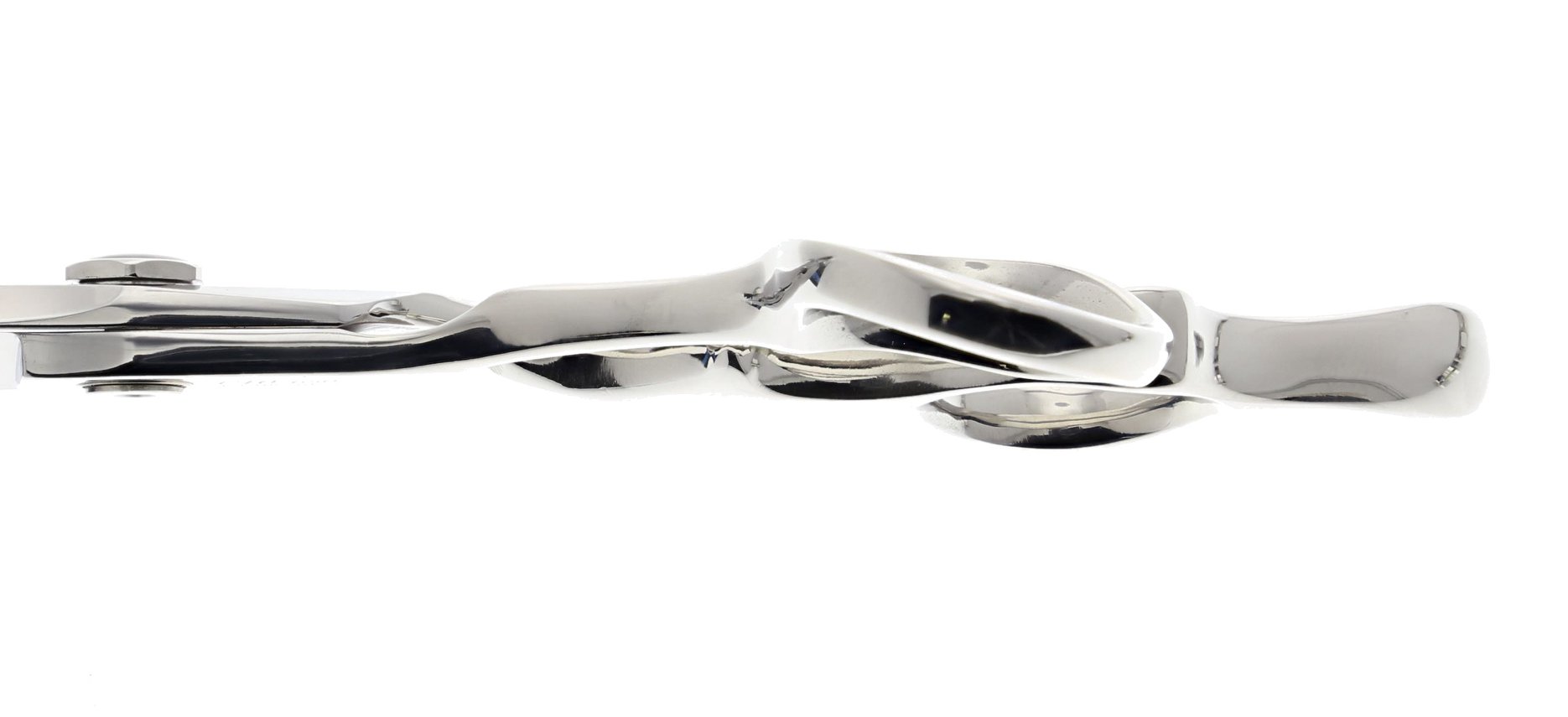
Biomechanics and Ergonomic Design in Professional Shear Selection
Daily salon work demands thousands of cutting repetitions, exposing the wrist joint, elbow, and shoulder complex to constant biomechanical stress. Choosing the right handle geometry in high-end professional shears is not just an aesthetic preference: it determines a stylist’s posture, reduces muscle fatigue, and prevents long-term occupational injuries like carpal tunnel syndrome and rotator cuff tendinitis.
Understanding the structural differences between a Crane handle and a Swivel handle allows stylists to select the ideal tool based on their unique anatomy and primary cutting techniques.
Crane Handle: Anatomical Alignment and Elbow Relief
The Crane geometry features a sharp downward angle from the tension system toward the finger rings, dropping the thumb ring away from the center line of the blades.
Biomechanical Alignment: Dropping the thumb position allows stylists to keep their blades horizontal without raising their elbow or abducting their shoulder. The arm rests in a neutral, relaxed position close to the body.
Reduced Muscle Strain: Relieves tension in the trapezius muscles and wrist extensors, decreasing intra-articular pressure during long blunt-cutting or sectioning sessions.
Recommended Use: Ideal for precision technical work, scissor-over-comb techniques, clean geometric lines, and stylists suffering from chronic neck and shoulder tightness.
Swivel Handle: 360° Mobility and Wrist Freedom
The Swivel system features a thumb ring mounted on a 360-degree rotating axis, making it independent of the shear body.
Dynamic Adaptability: The ring rotates freely with the thumb’s natural movement in any direction. The stylist’s hand finds its own comfort axis regardless of elevation or section angle.
Open-Palm Positioning: Enables cutting in vertical, diagonal, or reverse angles while keeping the hand open and relaxed, eliminating forced wrist bends.
Carpal Tunnel Prevention: Drastically reduces hyperflexion and hyperextension of the median nerve in the wrist, allowing extended work with minimal joint effort.
Recommended Use: Perfect for dry cutting, dynamic texturizing, high-angle point cutting, deep layering, and stylists with a history of wrist or thumb pain.3
Choosing Your Ideal Geometry
To maximize occupational health and cutting performance in the salon:
Mix Tools at Your Station: Using a Crane handle for foundational line work and a Swivel handle for detail and texturizing balances muscle strain throughout the day.
Ensure Proper Ring Fit: Use sizing inserts inside the finger rings to keep the thumb resting at the pad of the finger, allowing the handle geometry to perform ergonomically without overextending your grip.
Handle Geometry Comparison
| Feature / Benefit | Crane Handle | Swivel Handle |
| Primary Relief Area | Shoulder, neck, and elbow | Wrist, carpal tunnel, and thumb |
| Ring Mobility | Fixed downward angle | 360° free rotation |
| Elbow Position | Low, close to the torso | Completely free at any working height |
| Angle Versatility | Optimal for horizontal and precision lines | Superior for creative angles and texturizing |
| Learning Curve | Immediate / quick adaptation | Moderate (requires 2 to 3 days of practice) |


