


Razor Thinning vs. Point Cutting: Structural Differences in Fiber Ends for Volume Creation
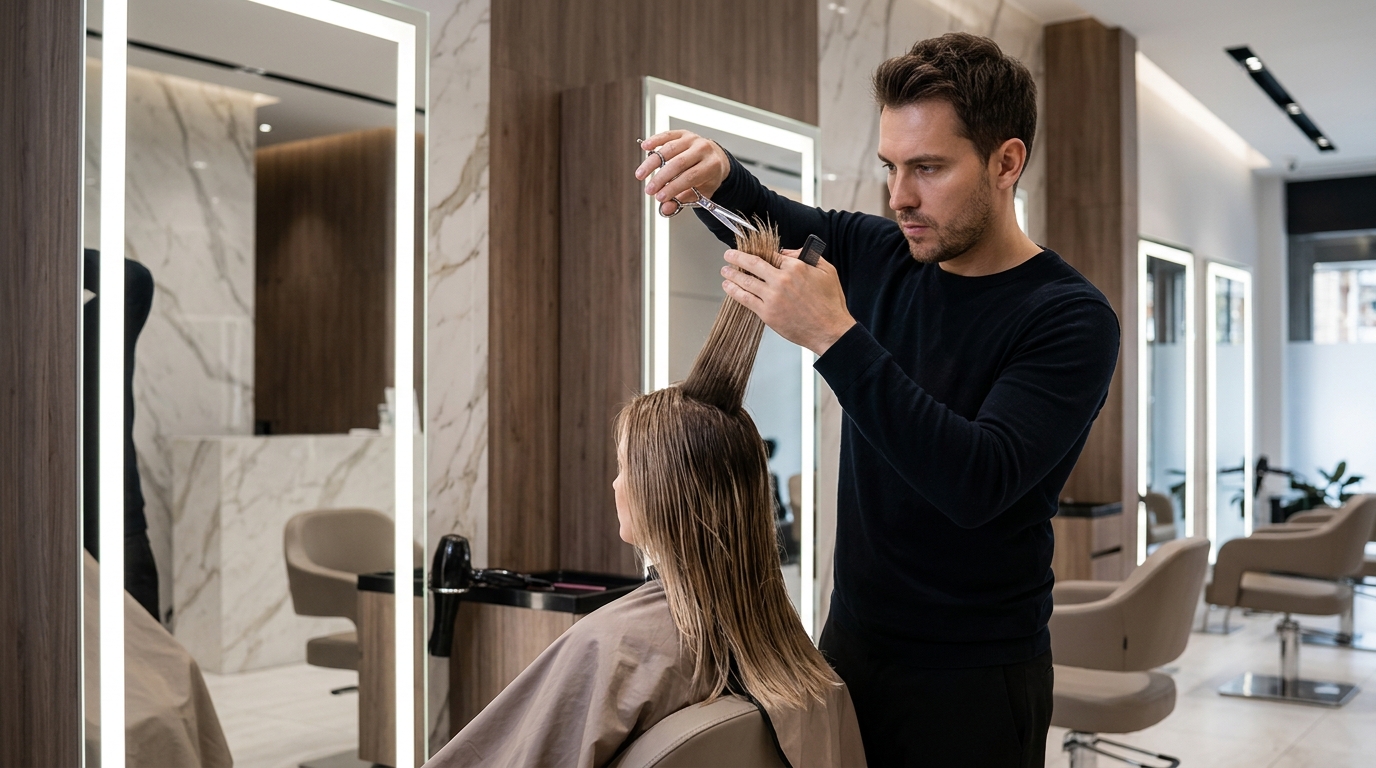
Texturizing is a core technique in technical haircutting, used to adjust weight distribution, introduce movement, and reveal natural volume. While both razor thinning and point cutting aim to soften dense sections and enhance movement, they interact with the physical hair fiber in fundamentally distinct ways. The choice of tool—a razor blade versus traditional shears—directly dictates the microscopic cross-section of the hair tip, altering how individual strands slide past each other, support adjacent growth, and hold shape over time.
Understanding the structural impact of each tool allows stylists to select the precise texturizing method based on fiber diameter, elasticity, and cuticle integrity.
Microscopic Fiber Cut Mechanics
The primary structural distinction between razor cutting and point cutting lies in the angle and force applied to the individual hair strand:
Razor Thinning (Feathered Taper Cut): A razor blade cuts the hair strand at an extreme diagonal angle as it glides along the shaft. Microscopic inspection reveals a long, tapered, ribbon-like tip. This elongated bevel reduces tip mass gradually, allowing hair ends to bend effortlessly and seamlessly stack over neighboring strands.
Point Cutting (Blunt Geometric Notching): Shears cut the hair using a dual-blade shearing force. When point cutting, the blade enters the section vertically or diagonally, creating small, V-shaped notches. Each individual cut strand retains a blunt, flat cross-section at its tip, preserving structural density at the micro-level while creating space between section groups.
Impact on Hair Volume and Structural Support
Weight reduction alone does not guarantee volume; the physical shape of the cut tips determines how hair behaves when styled:
Volume via Support (Point Cutting): By leaving short, blunt-tipped interior strands mixed among longer sections, point cutting creates microscopic structural pillars. The firmer, blunt ends of the shorter strands push against the longer strands, providing mechanical lift and foundational support at the roots and mid-lengths.
Volume via Fluidity (Razor Thinning): The elongated, tapered tips created by a razor remove surface resistance between strands. This allows hair sections to collapse into hollows or flare outward smoothly, producing soft, airy volume that moves fluidly without stiff separation.
Hair Type and Fiber Condition Compatibility
Because a razor blade scrapes across the cuticle before severing the cortex, tool selection must align with the client’s hair texture and structural health:
Straight to Medium Fine Hair: Excellent candidate for razor thinning. The tapered ends create touchable texture and motion in hair that otherwise lays flat or heavy.
Coarse, Thick, or Low-Elasticity Hair: Responds best to point cutting. Pointing removes heavy interior pockets without weakening the outer cuticle layer or creating frizzy ends.
Curly, Coily, or Highly Porous Hair: Proceed with extreme caution when using a razor. Scraping the cuticle of textured or porous hair disrupts the protective 18-MEA lipid layer, causing cuticle lifting, immediate frizz, split ends, and moisture loss. Point cutting in natural fall preserves curl cluster integrity while selectively carving out bulk.
Salon Execution Best Practices
To ensure clean execution and maintain fiber health during texturizing services:
Always Use a Fresh Razor Blade: A dull razor pulls and tears the cortex rather than slicing it cleanly, resulting in frayed ends and premature splitting.
Maintain Correct Moisture Levels: Razor cutting must always be performed on evenly damp hair lubricated with a cutting lotion to reduce friction. Point cutting can be executed on either wet or dry hair depending on whether you are establishing primary architecture or reviewing natural fall.
Control Blade Elevation: When using a razor, keep the blade at a low angle relative to the hair section (15 to 30 degrees). Steeper angles scrape the cuticle excessively without making clean structural cuts.
Depth Control in Point Cutting: Adjust the depth of your shear insertion based on density. Deep point cutting (cutting 1 to 2 inches into the section) removes interior weight, while shallow point cutting (cutting only the outer half-inch) softens baseline edges without altering internal support.
By matching the micro-structural output of razor thinning and point cutting to the hair’s natural physical traits, stylists can craft weightless volume while preserving long-term fiber health.


